
Demand
ABC-XYZ Inventory Calculator: Classify Your SKUs
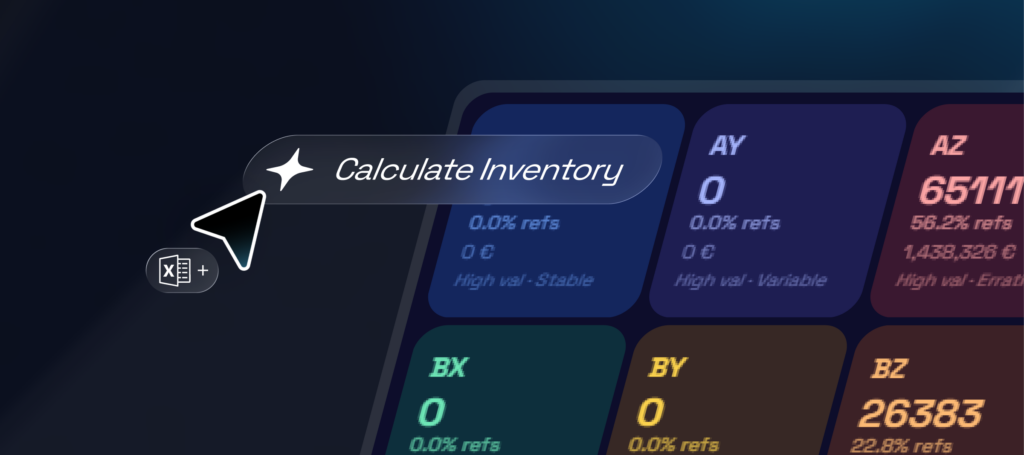
The ABC-XYZ Inventory Calculator is a free web tool that helps you classify your portfolio by combining two key criteria: each product’s importance to the business and the variability of its demand. Its goal is to help you prioritize items, define differentiated policies and understand which products require closer control, review or analysis within your planning process.
To get started, upload a CSV file with your historical product data. The file must include, at a minimum, the product code or reference, a value assigned to each item and enough data to measure demand variability. That value can represent sales, consumption, revenue or margin, depending on the criterion you want to use to assess each product’s business importance.
Once the file is uploaded, the tool calculates the ABC classification. This classification measures each product’s weight within the portfolio. As a standard approach, A products typically represent around 80% of cumulative value, B products reach up to 95% and C products account for the remaining share. These thresholds can be adjusted to better reflect your business reality.
Next, the tool calculates the XYZ classification. This dimension measures each product’s demand variability or forecasting difficulty. X products are more stable and easier to predict, Y products show moderate variability and Z products are more volatile or harder to anticipate. The tool includes standard parameters, but you can adjust them if you have a strong understanding of your demand behavior.
When you run the calculation, you get an ABC-XYZ matrix that combines both dimensions. This matrix helps you quickly identify which products are critical and stable, which are important but difficult to forecast and which items have low impact but high variability. When you select a cell in the matrix, the product table automatically filters so you can analyze that specific group.
In addition to the matrix, the tool displays several visualizations to help you interpret the results. Bar and donut charts show how many items fall into each category and how much they contribute to cumulative value. The scatter plot shows each product’s position based on importance and variability, making it easier to identify borderline cases or items that require deeper review.
Finally, you can review the detailed table to analyze each item individually. This information can be used to define differentiated policies for inventory, procurement, forecast review and operational control.
As a result, you get a clear segmentation of your portfolio. This classification helps you prioritize your most strategic products, better control items with more variable demand and make smarter decisions around stock, procurement and planning.